



Do you need to know music theory to write a song? No… You don’t need to know music theory to write a song! The truth is, there’s no right and wrong way to make a song. As long as the end product moves you, who matters how you got there?
Songwriting is spiritual and you shouldn’t stifle creativity with a rule book. After all, as songwriter Harlan Howard said… “Country music ain’t nothin’ but three chords and the truth.” He should know, he’s written hits for country singers like Patsy Cline, and Johnny Cash!
But… and it’s quite a big but…
Importance of Music Theory in Songwriting
A little knowledge goes a long way! No doubt, even the basics of music theory will help in your quest to make a song. It’ll make picking the next shape in chord progressions easier and melody creation a touch smoother.
When I started playing the guitar, learning music theory was the last thing on my mind. Why would I want to know how to learn music theory? Sitting in classrooms isn’t very rock and roll, is it?
I’d played some of the biggest shows of my career before learning music theory. Yeah, I knew what sounded good, but I didn’t know why it sounded good. Unbeknown to me, I was stepping away from the norm after experimenting with alternative tunings. But I only knew this once a friend who had a formal education in music told me after seeing a live show. But for me, trial and error will only go so far.

So, I had piano lessons. It blew my mind and made me a better musician and songwriter. Those lessons made me understand the whys and hows. Thus making me more knowledgeable and adventurous with my songwriting. There is no doubt about it, though. I did things backwards—the classic wagon before the horse.
Don’t get me wrong, I still strongly believe there’s a spiritual element to songwriting. But it’s a matter of bolstering your arsenal to increase your chances of success.
Before you think “I don’t want to sit in a classroom learning”… it doesn’t have to be that way.
Music Theory for Dummies: Simplified Music Theory
Let’s keep this as simple as possible. To get started, you don’t need to know subdominants from your supertonics. And no, a supertonic isn’t a gin mixer. Let’s break what I’ve learned into the simplest possible way I can explain:
- To write a song, you’ll need a chord sequence.
- A chord sequence is in a key. Usually, you can find the key of a song by identifying the first chord you play in that progression.
- Once you know the key, there’s a set of notes to play.
- You can play a lead riff or sing any note in that key over your chord progression.
If you really want to simplify it, any song in the key of C major means you just play the white keys on a piano. That’s the notes… C – D – E – F – G – A – B. These notes will work on any instrument, as long as it’s tuned, of course. Or if you’re feeling a little sadder use a minor key. C minor comprises… C – D – E♭ – F – G – A♭ – B♭.

Many websites can show you the scales. It’s a quick search away. There are even free sites like ScalesChords that can help you identify the key to a song from notes or chords.
It’s really that simple! Well, at least the basics are.
How To Learn Basic Music Theory
Everyone’s journey is unique. Why did piano lessons work for me? Well, it’s visually accessible. Especially when you can write the notes on an old second-hand keyboard. On the other hand, it can take longer to memorise the notes of a guitar.
Another reason piano worked for me is the MIDI keyboard. If you’re hoping to produce your own material, whether or not that be a demo, you can use the MIDI to program all manner of virtual instruments. If you know the basics of piano, you have the world at your fingertips.
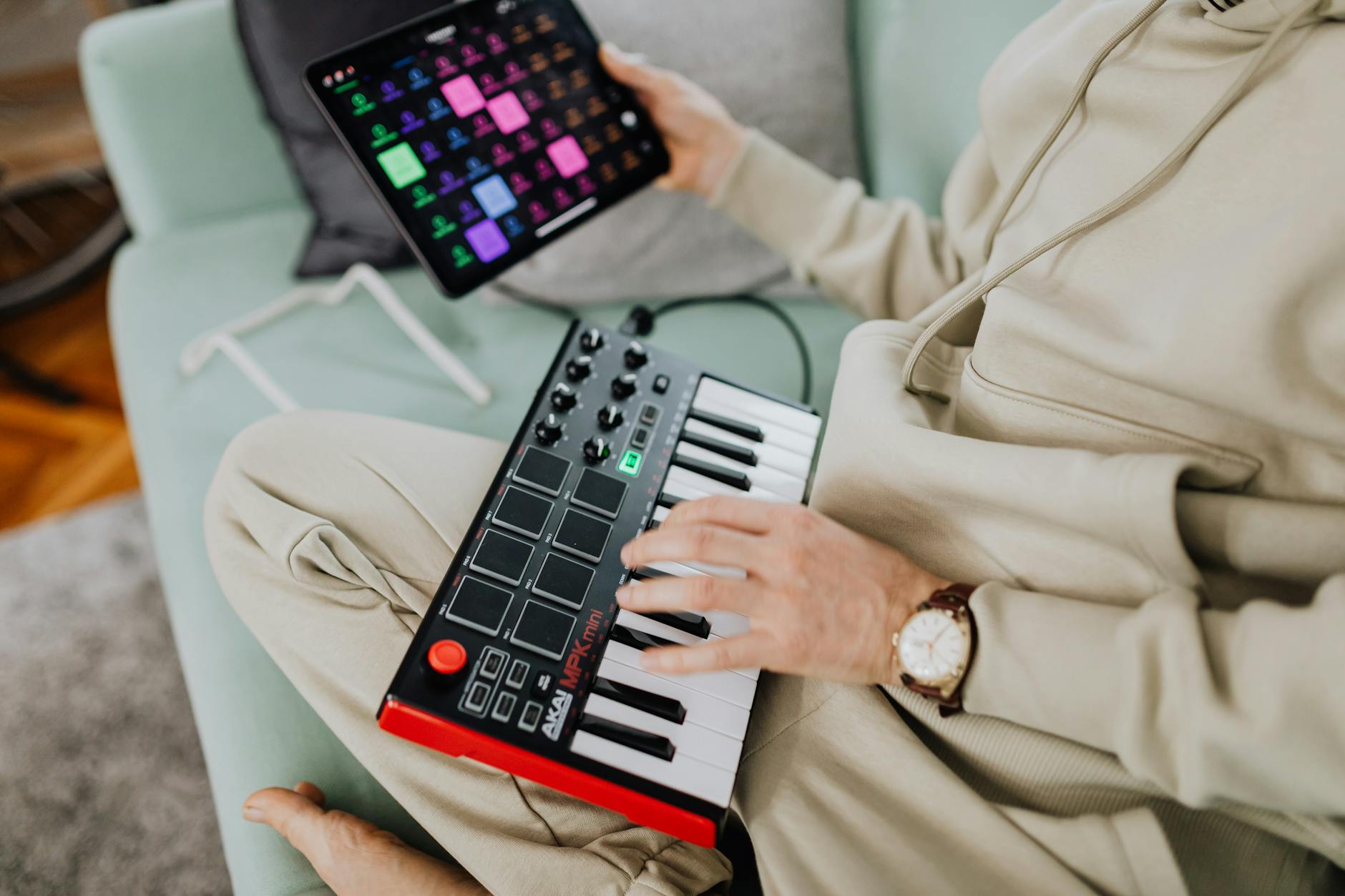
From sweeping orchestration to synth lines, MIDI is integral to the modern-day producer and songwriter. I knew, if I wanted to self-produce, I’d need to know the basics at least.
I’ve found Piano4All one of the best around for learning. As it says on their website… “Unlike courses that teach you to copy random songs, You’ll develop a deep understanding of music theory, chord structures, and patterns that you can apply to mastering any song or creating your own unique compositions.”
It’s a one-off payment so you can learn at your pace. That said, depending on your level of self-discipline, you may prefer other ways to learn.
Different Ways to Learn Basic Music Theory:
- In-Person Lessons: Many people respond to the personal approach to learning. There’s a level of accountability when you have weekly lessons. Same time, same place, you can’t skip to play your game console. This is a friendly approach if you’re prone to procrastination and can offer catered advice.
- YouTube Tutorials: There are countless free tutorials available for every instrument on YouTube. Again, you’ll need self-discipline here and it won’t be personal advice. The positives are it’s free!
- Books: Remember books? Reading was how I first learned guitar. Before the internet, I’d save lunch money to buy a guitar magazine. From that magazine, I learned ‘Wonderwall’ and it would be the first complete song I could play. “Music Theory for Dummies” is a great resource. I like how it breaks down complex concepts into easy-to-understand sections.
- Online Courses: For a more formal approach, websites like Coursera and Udemy offer comprehensive courses on music theory. You can take them at your own pace and get a qualification at the end.
So, once you’ve got the basics, you can apply it to anything from screaming guitars to pop-perfection synths to make a song.
How Long Does it Take to Learn Music Theory?
If you want a definitive answer, then unfortunately you won’t get it here. See, learning music theory is a multifaceted question. In theory, excuse the pun, you could pick up the basics within the length of a YouTube video. But, it depends on your current knowledge.
And that’s the basics, if you want to learn complex techniques then people spend years studying and a lifetime of discipline to reach peak knowledge.
Experience versus Theory
Should you learn music theory? In my experience, yes. I’m not denying you can’t write a song without, but the knowledge will make things a lot easier by taking away the guesswork and in turn saving time.
That said, people with a wealth of music theory knowledge sometimes can’t write songs. Songwriting is like a sport. The more you do it, the better you’ll get. So write. Discard the bad ones and keep going, because it will click. Songwriting experience alongside music theory know-how is a killer combo.
I suppose at this point, it’s also worth mentioning that many facets make a song great. None more so than the lyrics. Music theory will help you write a melody but the lyrics… not so much. From Elton to Bernie to Richards and Jagger, history has its songwriter duos. Sometimes, if you excel in an area, you might just need to find your match to help where you fall short.
Practical Application of Music Theory in Songwriting
Understanding music theory can transform your songwriting process. Wondering where learning the basics can help? Here’s how:
- Chord Progressions: You can use even the simplest and most common chord progressions. This is your foundation. It’s from the chord progression that you’ll build lead melody lines over the top. For example, the I-IV-V progression is a sure-fire hit. In the key of C, that is C – F – G.
- To prove that point. Here’s a list of songs over the decades that have used the C – F – G tried and true chord progression.
- Hound Dog – Elvis Presley (1950s)
- Honky Tonk Women – The Rolling Stones (1960s)
- Imagine – John Lennon (1970s)
- Glory Days – Bruce Springsteen (1980s)
- All Apologies – Nirvana (1990s)
- It Happens – Sugarland (2000s)
- Pontoon – Little Big Town (2010s)
- To prove that point. Here’s a list of songs over the decades that have used the C – F – G tried and true chord progression.
- Scales and Melodies: Familiarise yourself with major and minor scales. It’s the notes in the scales that you can use to create interesting melodies. Whether that be a guitar line, synth melodies, or vocal choruses. By knowing scales, you can identify the notes that fit well with your chord progressions.
- Rhythm and Timing: While most pop music is 4/4 timing. If you learn different time signatures and rhythmic patterns you can add complexity and variety to your songs.
Conclusion
So let’s summarise. You don’t need to know music theory to write a song. WIth three chords and life experience, you can create a song. However, having a basic understanding will enhance the songwriting process. It will simplify creating chord progressions. Plus when you have those chords you’ll know what melodies to put over the top. That knowledge will save you time and effort.
Remember, even legendary musicians like Paul McCartney can’t read music. And he’s created some of the world’s most famous songs without formal music education. Even with the basic knowledge of music theory, the key is to keep writing and refining your craft.
In the days of MIDI basic piano skills are a MUST for producers and self recording artists. With that in mind, Piano4All offers an excellent course to get you started on your musical journey. For the sake of transparency, as an affiliate, I earn a commission from some links. See, Spotify streams pay a fraction of a cent per play, more on that in another blog. But every little bit helps keep the lights on!
Happy songwriting!
 Independent Artist Advice:
Leave a comment